

By Gareth Timmins, Founder of NOUGHT POINT ONE™
“Do one thing every day that scares you.” – Eleanor Roosevelt
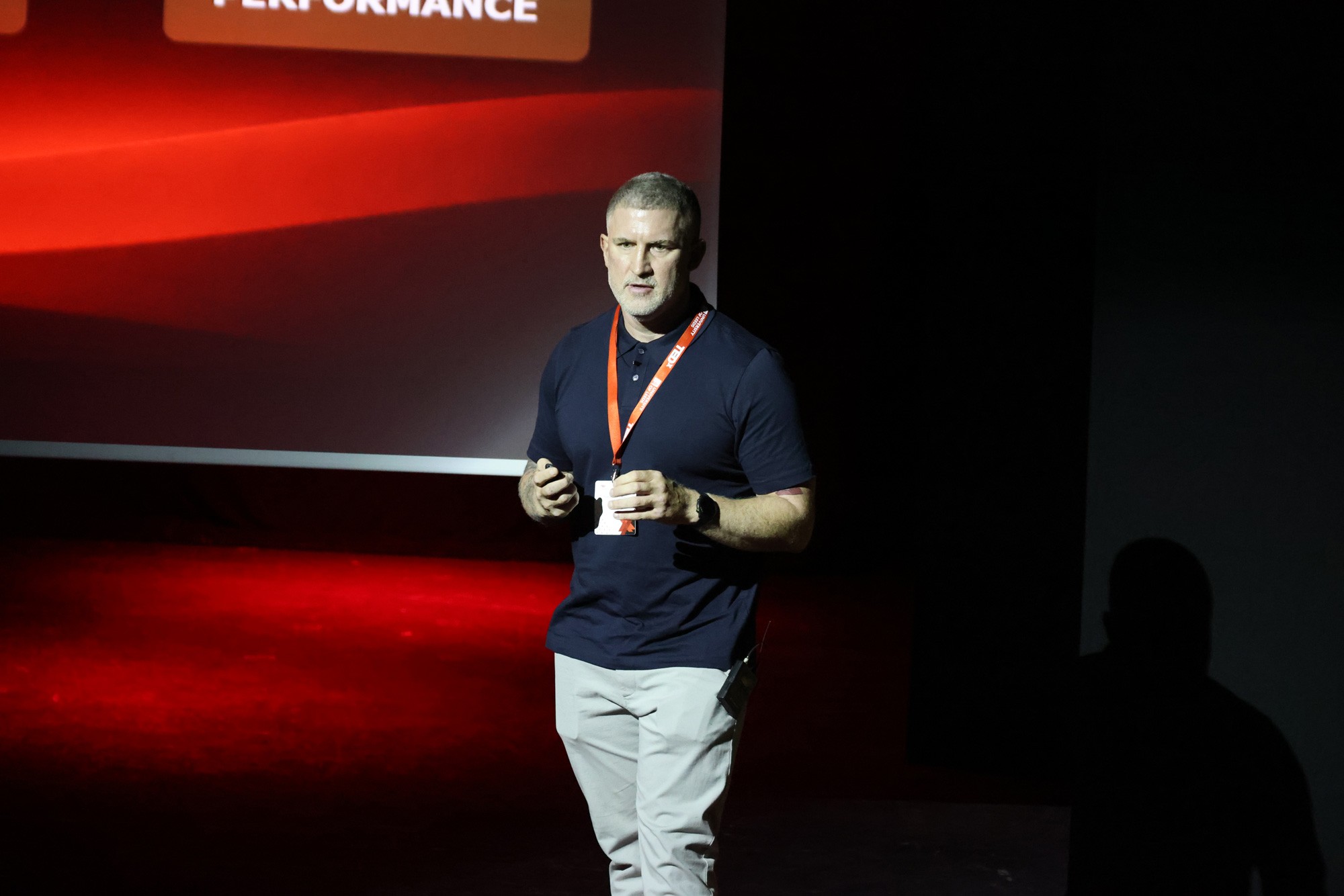
Yesterday, I stood on a TEDx stage.
It’s one of those moments that sounds exciting when you tell people afterwards, but the reality feels very different in the moments leading up to it.
Standing backstage, microphone fitted, countdown running, there is nowhere to hide. No distractions. No excuses. Just you, your thoughts, and a red dot on the floor waiting for you to step onto it.
For all the confidence people often associate with public speaking, the truth is that pressure doesn’t disappear simply because you’ve experienced it before. The mind still asks the same questions.
What if you forget your lines?
What if your mind goes blank?
What if you’re not as prepared as you think you are?
Pressure has an incredible ability to expose the stories we tell ourselves.
As someone who spends much of my professional life researching and exploring performance under pressure, I found myself reflecting on something we do in psychology. When researchers want to study human stress responses in a laboratory, one of the most widely used methods is the Trier Social Stress Test (TSST). Participants are asked to deliver an impromptu speech and complete challenging mental arithmetic tasks in front of a panel of expressionless observers. It is specifically designed to trigger the social-evaluative threat that humans are wired to fear.
In simple terms, psychologists deliberately place people in situations where they feel judged, evaluated, and exposed because it reliably creates stress.
TEDx felt like a real-world version of that experiment.
Cameras on. Timer started. One take.
When it comes to TEDx, there are no second attempts, no “let’s do that again”, and no opportunity to stop and collect your thoughts. The clock continues to move, the audience continues to watch, and your nervous system knows it.
Months of preparation, countless revisions, rehearsals and reflections ultimately come down to a single opportunity to deliver when it matters most.
No retakes.
No editing.
No second chances.
Just you, your message, and a red dot on the stage.
 The experience itself was fascinating because, despite understanding the psychology of stress, you still experience it. Your heart rate increases. Your attention narrows. Your internal dialogue becomes louder. In that moment, all the theories, models and research become very real.
Yet once you step onto the stage, something interesting happens.
You stop thinking about yourself.
Your attention shifts away from your fears and towards the message.
And that, perhaps, is where performance lives.
Not in confidence.
Not in motivation.
Not even in talent.
But in service.
When your focus moves from “How am I doing?” to “How can I help?”, many of the emotional alarm bells begin to quieten.
 Looking back, what strikes me most isn’t the talk itself. It’s the reminder that growth continues to sit beyond comfort.
Whether it’s stepping onto a TEDx stage, starting a business, changing direction in life, having a difficult conversation, or pursuing an ambition that feels slightly beyond your current capabilities, the process is remarkably similar.
Discomfort arrives first.
Growth follows later.
The challenge is that most people wait for confidence before they act.
In reality, confidence is often the reward for action.
The red dot is a powerful symbol. Not because of what happens on it, but because of what it represents: the willingness to step forward despite uncertainty.
As researchers, leaders, parents and human beings, perhaps we shouldn’t be trying to avoid stress altogether.
Perhaps we should be learning how to regulate ourselves within it.
Yesterday, I did something that scared me.
And that’s exactly why it was worth doing. 🔴